Low-carbon heat for our terraced streets
The problem
About 17% of the UK’s carbon emissions come from heating buildings, so we urgently need to switch to heating systems that don’t rely on oil, gas or coal. For most homes, the answer will be a heat pump, which takes heat either from the air, the ground or a nearby water source. Heat pumps are an incredibly energy-efficient source of heat – they produce around 3 to 4 units of heat per unit of electricity, compared to 0.9 for a gas boiler. If you’ve got the money and space for an air-source heat pump, chances are it’s your best option (and you can get a £7,500 grant from the government).
However, getting every single household in the UK to switch individually to a heat pump is going to be a slow and difficult job – and they take up space, which is very limited in many Norwich homes. For many areas of high-density terraced houses or flats, a heat network is likely to be a better solution.

What is a heat network?
A heat network means one heating system providing heat and hot water (and sometimes cooling) to multiple homes or buildings, instead of every home having its own boiler. At the moment they cover about 3% of UK heat demand, but this is expected to rise to 20% by 2050. Most existing networks are communal heating – a block of flats with a plant room and a gas boiler sending out heat to all the flats. Some are district heating, which means they supply multiple buildings.
Heat networks are more efficient than systems that just heat a single home, meaning less heat is wasted. They are well suited to air-, ground- or water-source heat pumps. In some cases, they can make use of waste heat from a nearby industrial site or waste water treatment plant. Each home usually has its own heating controls and is charged for the metered heat it uses.
Because they don’t require every home to have its own heat source, heat networks are also cost-effective and require less space in the home. So they could be an ideal solution for a lot of Norwich’s terraced housing and flats.
What we’re doing
We’re working with Norwich City Council to explore possibilities for a low-carbon heat network in a terraced street (or cluster of streets), probably in either NR2 or NR3. This will be designed to meet the needs of Norwich’s Victorian terraced houses and will be modular, so that it can be extended across whole neighbourhoods.
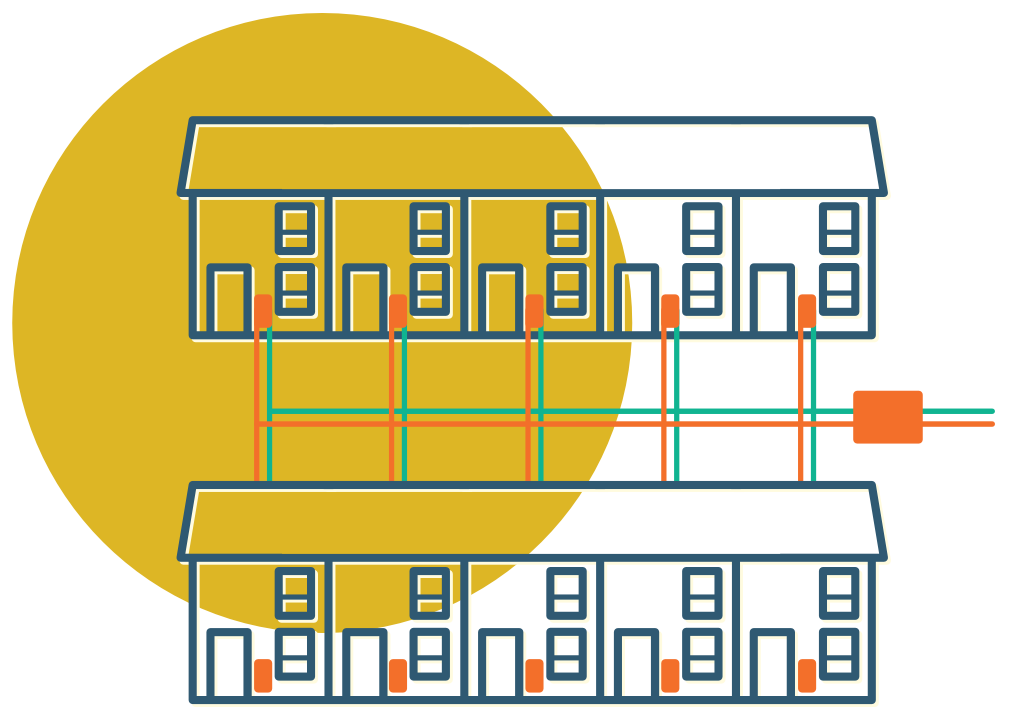
We are seeking funding for a feasibility study which will investigate options, but the most likely solution is an open-loop ground source heat network. This means the heat would be sourced from groundwater pumped up through boreholes and supplied to heat pumps situated on the street. These extract heat from the groundwater and use it to raise the temperature of (different) water which is then fed to a heat interface unit in each house – these are a similar size to a gas boiler. The groundwater is then returned to the aquifer where it takes heat from the ground to return to its previous temperature.
This type of system can also be used for cooling. It’s extremely efficient, but will only work if it’s possible to access the aquifer – so this is one of the things we need to find out.
As more houses join the network, more boreholes and heat pumps can be added.
We’re looking for an area which:
- has high-density terraced housing with limited indoor and outdoor space
- has a reasonable number of long-term residents – it will be difficult to make this project happen if people don’t stay living in their houses for long
- has a few keen residents who can help recruit others!
If you think your street would be a good fit for this pilot and you’d like to be involved, contact Livvy at livvy@ourpower.org.uk.